The Chemistry of Second Chances: How Bezwada Biomedical is Rewriting the Rules of Surgical Healing
Innovators of the Year 2026
Every year, engineers across the medical device sector conceive breakthrough products that never reach an operating room. The idea is sound. The clinical need is real. Yet the project stalls at a quiet, unglamorous checkpoint: the material itself. Off-the-shelf absorbable polymers, however well established, were never designed with the flexibility to match every implant, every scaffold, or every localized therapy a modern surgeon requires.
Mechanical strength, degradation timing, and tissue interaction are rarely tunable on demand, and device developers are frequently forced to compromise their designs to fit the chemistry available to them, rather than the reverse.
This mismatch has quietly slowed the pace of innovation in orthopedics, wound care, drug delivery, and regenerative medicine for decades. As the industry pushes toward minimally invasive procedures, patient-specific implants, and bioprinted tissue, the demand for precision-engineered materials has only intensified. Few organizations have been positioned to close that gap.
Bezwada Biomedical, LLC, founded in Hillsborough, New Jersey, has spent more than two decades doing precisely that, supplying the molecular building blocks that allow medical device makers to translate ambitious ideas into approved, marketable products.
A Scientist Who Chose to Build Rather Than Wait
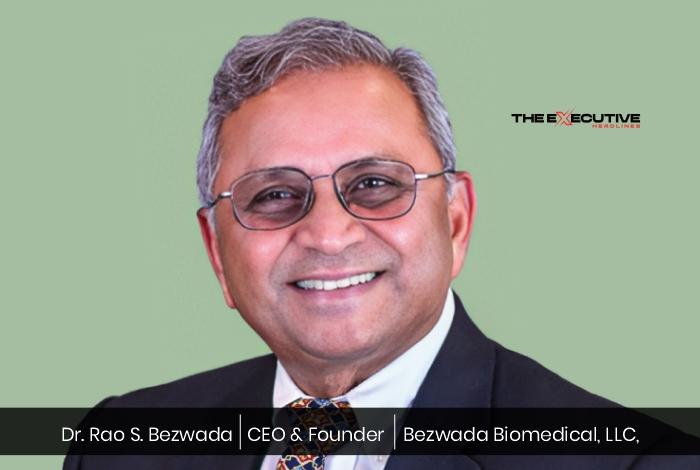
At the center of this enterprise stands Dr. Rao S. Bezwada, Founder and Chief Executive Officer, a polymer chemist whose career spans more than forty years. Long before establishing his own company in 2003, he spent over two decades at Ethicon, a Johnson & Johnson enterprise, where his research contributed to the development of MONOCRYL®, an absorbable monofilament suture that reshaped surgical wound closure worldwide and remains in wide clinical use today.
That accomplishment earned him the Johnson Medal from Johnson & Johnson in 1996, an early signal of the influence his chemistry would eventually have on patient care.
Rather than settle into a legacy role at a large corporation, Dr. Bezwada chose to build something narrower and, in many respects, more ambitious: a company dedicated entirely to absorbable biomaterials science. He holds more than 150 issued United States patents, an intellectual property portfolio that underscores both the depth of his technical output and the scale of the platform he has assembled around it.
Designing Chemistry Around the Patient, Not the Other Way Around
What separates Bezwada Biomedical from conventional material suppliers is the direction of its design process. Rather than offering a fixed polymer and asking device makers to adapt their applications to it, the company starts with the clinical problem and engineers the molecule to answer it.
A tissue adhesive, an orthopedic scaffold, and a drug-releasing implant each carry distinct performance requirements, and a single universal material can rarely satisfy all three.
To meet this challenge, the company operates a suite of proprietary technology platforms encompassing absorbable polyurethanes, polyoxaesters, polyesteramides, amino acid-based polymers, functionalized drug-releasing polymers, antimicrobial systems, nitric oxide-releasing materials, and bio-based biodegradable polyurethanes.
Adjustments to monomer composition, crystallinity, molecular weight, and crosslinking density allow researchers to fine-tune strength, elasticity, and hydrolysis rate at a molecular level, giving device developers unusually precise control over how a material behaves once implanted.
Turning Laboratory Insight into Cleared Products
Perhaps the clearest evidence of this approach is the company's absorbable polyurethane platform. Traditional medical-grade polyurethanes offer excellent mechanical durability but resist breakdown inside the body. Bezwada Biomedical addressed that limitation by introducing hydrolysable segments into the polymer backbone, preserving polyurethane-level performance while enabling controlled, predictable degradation.
That innovation now underpins a commercial partnership with Abyrx, whose MONTAGE® family of bone hemostat products has secured more than fifteen FDA 510(k) clearances, offering tangible proof that the underlying chemistry translates successfully from bench to bedside.
Additional platforms extend the company's reach further: TissuBond™, an absorbable tissue adhesive and sealant supported by NSF SBIR Phase I and Phase II funding; ECO-BIOMAXX™, a bio-based biodegradable polyurethane line balancing environmental responsibility with clinical performance; and a growing portfolio of bioinks engineered for three-dimensional printing and organ bioprinting applications.
Earning Credibility in a Skeptical Industry
Operating as a comparatively small enterprise inside a heavily regulated field presented its own set of obstacles. Bezwada Biomedical had to demonstrate, project after project, that a focused innovation-driven company could deliver results on par with far larger organizations.
It also had to convince customers of a subtler point: that absorbable polymers function as enabling technologies rather than interchangeable commodities, where a minor adjustment in chemistry can meaningfully alter degradation behavior or tissue response.
This experience shaped Dr. Bezwada's leadership philosophy, which pairs scientific ambition with methodical rigor. He encourages his team to explore beyond conventional solutions while insisting on disciplined experimentation, thorough documentation, and long-term commitment to quality, a balance reflected in the company's ISO 13485 certification for its quality management systems.
Reading the Future of Medicine Before It Arrives
Dr. Bezwada views the accelerating adoption of robotics, artificial intelligence, and biofabrication as forces reshaping what medical materials must accomplish. Robotic-assisted surgery calls for adhesives that set quickly and perform reliably in constrained anatomical spaces. Bioprinting requires polymers capable of forming patient-specific scaffolds.
Regenerative medicine demands materials that guide tissue repair and then disappear on a precise schedule. Artificial intelligence, he notes, can accelerate formulation screening and performance prediction, yet experimental validation remains irreplaceable in biomaterials science; the path forward combines data-driven tools with seasoned scientific judgment gathered directly from clinicians and industry partners.
A Philosophy Measured in Patient Outcomes
For Dr. Bezwada, the ultimate measure of success is neither patent count nor publication record, though both are substantial. It is the moment a surgeon's hands benefit from improved material handling, or a patient avoids a permanent implant because a resorbable alternative did the job instead.
This conviction traces directly back to MONOCRYL®, and it continues today through the MONTAGE® collaboration with Abyrx, where absorbable polyurethane chemistry helps manage bone bleeding without leaving foreign material behind.
Guidance for the Next Generation of Innovators
Asked what advice he would offer emerging leaders in medical device development, Dr. Bezwada points to patience, data-driven validation, and unwavering attention to the patient.
Failures, he notes, are inevitable in this field and often instructive. He also urges leaders to think in platforms rather than single products, since one well-engineered technology foundation can generate solutions across many clinical categories.
A Legacy Written in Molecules
Looking toward the future, Dr. Bezwada hopes Bezwada Biomedical will be remembered for purposeful innovation: safer, smarter absorbable materials that ease patient burden and expand what medical devices can achieve. If the company's chemistry continues to help surgeons treat patients more effectively, and inspires a new generation of scientists to apply polymer science to human health, he considers that outcome the truest measure of the company's legacy.
Business News
Tyson Foods Shakes Up Its Beef Business: These Major Plant Closures Could Change Everything
From Army Veteran to Award-Winning Entrepreneur: Danielle King’s Inspiring Rise to Success
Amazon Business Hits $60 Billion, How Agentic AI Is Revolutionizing B2B Procurement
How Community Bank Delaware’s $1,000 Donation Is Strengthening the Future of Lewes Firefighters
Autodesk Just Launched a Game-Changing Program Every Small Business Should Know About