How DataRobot Turns Enterprise Data into Automated Decisions
Innovators of the Year 2026
Enterprises across the globe now generate more data in a single day than most organizations produced in an entire year, a decade ago. Yet, despite this abundance, a persistent paradox continues to trouble boardrooms worldwide: the more data a company collects, the further it often drifts from timely, confident decision-making.
The shortage of skilled data scientists, the complexity of building and maintaining machine learning models, and the mounting pressure to govern artificial intelligence responsibly have combined to create a genuine industry bottleneck. Business leaders find themselves holding vast reservoirs of information while lacking the tools, talent, or time to convert that information into action.
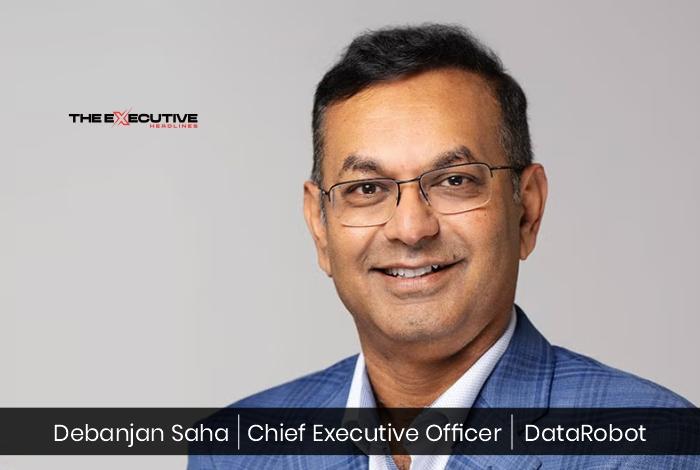
This gap between raw data and usable intelligence has become one of the defining operational challenges of the current business era. Regulatory bodies demand transparency, customers expect real-time personalization, and competitors move quickly to adopt generative tools, all while many organizations remain stuck at the experimentation stage of their AI journey. It is within this landscape of unmet potential that DataRobot, a global provider of AI Cloud solutions, has positioned itself as an answer, and at the helm of that answer stands its Chief Executive Officer, Debanjan Saha.
Leadership Team
Debanjan Saha carries more than twenty years of technical and operational leadership experience, shaped through senior positions at some of the most influential names in modern computing, including Google, Amazon Web Services, and IBM. Across these roles, he built deep expertise in cloud infrastructure, large-scale data systems, and the engineering discipline required to bring emerging technology to enterprise scale.
Saha stepped into DataRobot in February 2022, initially serving as President and Chief Operating Officer, before assuming the role of Chief Executive Officer in September of that same year. His academic and technical standing is further reflected in his recognition as an IEEE Fellow and Distinguished Member of the ACM, alongside credit as co-author on more than fifty patent applications. These accomplishments position him not merely as a corporate executive, but as a practitioner who has spent his career building the very technology he now oversees at an organizational level.
A Platform Designed to Answer the Industry's Core Problem
DataRobot was established in 2012 by founders Jeremy Achin and Thomas DeGodoy, with a founding purpose of automating machine learning so that data-driven decisions would no longer depend exclusively on scarce specialist talent. Headquartered in Boston, Massachusetts, the company has grown into a unified AI Cloud platform capable of managing the complete lifecycle of artificial intelligence, from data preparation through model construction, deployment, and ongoing governance.
Where many organizations struggle to translate predictive analytics into daily operational value, DataRobot's platform is engineered to close that exact distance. It brings together automated machine learning, generative AI functionality, and lifecycle management tools under a single environment, allowing both technical specialists and non-technical business users to build, deploy, and monitor models without unnecessary friction.
The company has secured more than one billion dollars in capital and reached a valuation exceeding six billion dollars, serving a client roster that includes several Fortune 50 organizations across finance, healthcare, and retail.
Reshaping Strategy Under New Leadership
Since assuming the chief executive role, Saha has pursued a series of deliberate strategic moves designed to strengthen the platform and rebuild trust among stakeholders. Rather than treating artificial intelligence as an abstract capability, his leadership has focused on tangible expansion across several fronts.
The AI Cloud platform itself has been broadened to integrate a wider variety of data types and deployment environments, allowing organizations to extract industry-specific insight regardless of their existing technical infrastructure. Saha also placed considerable emphasis on direct customer engagement, personally visiting more than one hundred clients across twenty cities worldwide, an approach intended to ensure that product development remains grounded in genuine customer need rather than theoretical demand.
Recognizing the rapid rise of generative AI as a business priority, Saha directed the integration of generative capabilities alongside DataRobot's established predictive modeling tools, giving enterprises access to both forecasting power and creative, real-time content generation within one ecosystem.
Given the growing regulatory scrutiny surrounding artificial intelligence, governance became another central pillar of his strategy. New features supporting automated compliance documentation and continuous AI observability were introduced, helping client organizations maintain transparency and regulatory alignment as they scale their AI initiatives.
Confronting Internal and External Pressures
Saha's leadership tenure has unfolded against a backdrop of genuine difficulty. He inherited an organization that had experienced considerable executive turnover, internal cultural strain, and financial headwinds, conditions that could easily undermine confidence among employees, investors, and customers alike. Rather than avoiding these realities, Saha has approached them directly, prioritizing transparency in communication, consistency in strategic messaging, and collaborative decision-making across departments.
The broader artificial intelligence sector presents its own set of external pressures. Economic uncertainty, aggressive competition from both established technology giants and emerging startups, and the constant need to differentiate DataRobot's offerings have all required careful navigation.
Saha's response has been to double down on the qualities that distinguish DataRobot from competitors: a comprehensive, governed, end-to-end platform rather than a fragmented collection of point solutions, paired with a leadership style that favors steady rebuilding over dramatic reinvention.
A Forward-Looking Vision for Enterprise AI
Looking toward the future, Saha envisions a marketplace in which artificial intelligence functions as a standard operational tool rather than a specialized experiment reserved for a handful of technically sophisticated firms. His ambition centers on positioning DataRobot as the platform that allows organizations, regardless of size or industry, to convert their accumulated data into confident, agile decision-making.
This vision requires more than technical capability. It calls for trust, built through consistent governance, and accessibility, built through a platform that welcomes both data scientists and business leaders alike. Saha's blend of deep engineering background and strategic business acumen appears well suited to this dual requirement, positioning him to guide DataRobot through the next phase of enterprise AI adoption.
Closing Perspective
The story of Debanjan Saha and DataRobot reflects a broader shift taking place across the business world: the movement away from data collection as an end in itself, toward data as a genuine engine of decision-making and growth. As enterprises everywhere confront the same bottleneck between information and insight, DataRobot's platform, and the leadership steering it, offer a working model for how that gap might finally begin to close.
Under Saha's continued direction, DataRobot stands positioned not simply to keep pace with the artificial intelligence movement, but to help define its next chapter for businesses across every sector.
Business News
Tyson Foods Shakes Up Its Beef Business: These Major Plant Closures Could Change Everything
From Army Veteran to Award-Winning Entrepreneur: Danielle King’s Inspiring Rise to Success
Amazon Business Hits $60 Billion, How Agentic AI Is Revolutionizing B2B Procurement
How Community Bank Delaware’s $1,000 Donation Is Strengthening the Future of Lewes Firefighters
Autodesk Just Launched a Game-Changing Program Every Small Business Should Know About